Tennis
Publié le 04.10.2026
Legal IPTV for Live Sports in the USA: How to Watch Every Match Without Breaking the Law
If you have ever clicked on a "free" streaming link five minutes before kickoff, only to be hit with pop-ups, buffering, and a nagging feeling that something about it is not quite right — you are not alone. Millions of American households are rethinking how they pay for television, and IPTV sits right at the center of that shift. But here is the part most articles skip: the legal line between a licensed IPTV service and a pirate operation is real, it is enforceable, and it matters to anyone who cares about staying on the right side of the law.
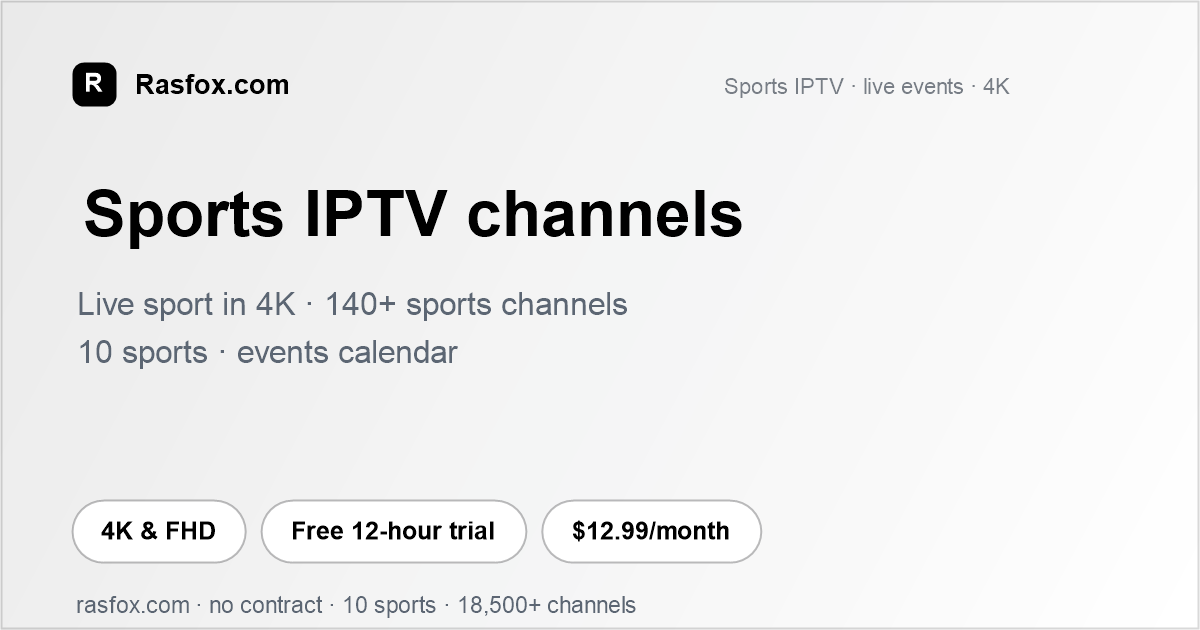
That is exactly the lens we are using here. This is not a generic "buy IPTV" pitch. It is a practical, legally-aware guide for sports fans in the United States who want reliable access to live football, basketball, Formula 1, and UFC — without gambling with fines, ISP warnings, or sketchy providers. And yes, we will show you what a properly built, sports-first service actually looks like.
What Is IPTV — and Why Does It Matter So Much for Live Sports?
IPTV stands for Internet Protocol Television. Instead of routing channels through a satellite dish or a coaxial cable, IPTV delivers them as data over your existing internet connection. Think of it as streaming, but organized like traditional television: numbered channels, an electronic program guide (EPG), and the ability to flip between a football match and a news broadcast in a second.
For sports fans specifically, IPTV solves three problems that cable never could:
- Geography. A fan in New Jersey can follow the Brasileirão. A student from Lagos in Houston can watch SuperSport. A Lisbon native in Boston can catch Liga Portugal.
- Cost. A traditional cable package with premium sports tiers frequently runs $100–$180 per month. A quality IPTV subscription is a fraction of that — and usually with no contract.
- Flexibility. No installation appointment, no equipment rental, no two-year lock-in. You bring the device; the service brings the channels.
The catch — and this is where the legal discussion begins — is that IPTV is a technology, not a business model. The same protocol can carry a fully licensed broadcast or a stolen feed. What separates the two is whether the provider holds distribution rights.
The Legal Angle: Why Sports Fans Should Treat Streaming Like a Contract
In legal terms, streaming is a licensing question. A broadcaster acquires the right to distribute a match in a specific territory. When a service retransmits that match without a license, it is infringing copyright — and in the United States, that can trigger statutory damages, DMCA takedown actions, and, in aggravated cases, criminal referral.
For the end user, the risk profile is different from that of the operator, but it is not zero. ISPs issue escalating copyright notices. Payment details used on disreputable platforms can be harvested. And "free" services are frequently funded by malware-laced ads — a very real cybersecurity issue for households that also bank, work, and store documents on the same network.
The practical takeaway is simple: treat your streaming choice the way you would treat any other contract. Ask who is providing the signal, whether they are transparent about their licensing, and whether they operate like a business or like a back alley.
If you want to dig deeper into the specific compliance questions that come up around subscription services, the analysis published on the best IPTV service for live sports is a reasonable starting point because it addresses licensing transparency directly rather than dodging the question. And if your concern is more about consumer protection and contract terms, legal guidance on streaming agreements covers the contractual fine print most users never read.
Why This Matters in the Real World: Sports, Budgets, and Household Rules
There is a second, quieter reason the legal question matters: cord-cutting is now a household financial decision, not just a tech hobby. When a family cancels a $150 cable package and moves to a $15–$20 IPTV subscription, that difference compounds month after month.
But a cheap service that dies in three weeks is not a saving — it is a loss. This is the same logic a lawyer applies to any risky contract: the cheapest option is only cheap if it performs. A legitimate provider with clear terms, refund policy, and 24/7 support is worth more than a bargain that disappears with your payment.
For readers who want to compare the economics against their current bill, cutting the cord with a licensed IPTV provider lays out what a realistic monthly saving looks like once you remove equipment rental and sports tier fees.
The IPTV Landscape in the United States: Channels, Sports, and What Actually Works
The U.S. market is unusual. Internet infrastructure is strong enough for 4K in most metro areas, but sports rights are fragmented across a dozen platforms — which is precisely why IPTV adoption keeps climbing among expat communities, bilingual households, and fans of sports that American cable simply ignores.
A sports-focused service in 2025 has to deliver more than a wall of channels. It has to deliver the right channels. That means:
- Worldwide sports: ESPN, DAZN, Fox Sports, beIN Sports, Sky Sports, TNT Sports, Eurosport
- Latin American feeds for Spanish-speaking households: TyC Sports, ESPN Deportes, Fox Deportes, DirecTV Sports
- Lusophone feeds for Brazilian and Portuguese communities: Globo, SporTV, Premiere, ESPN Brasil, BandSports, Combate, TNT Sports BR, plus Sport TV 1–6, Eleven Sports, and Benfica TV in Portugal
- African feeds for diaspora viewers: SuperSport, Sport TV Africa, ESPN Africa
On the competition side, the calendar is relentless: the NFL and NBA seasons, MLB, MLS, the UEFA Champions League, Premier League, La Liga, Liga MX, Liga Portugal, Liga Argentina, the Brasileirão, Copa Libertadores, Formula 1, and UFC pay-per-views.
This is the heritage behind the service we recommend. Its roots run through Radio Malena 89.1 FM in Buenos Aires (Venezuela 370) — a station steeped in tango and Argentine broadcast culture — which has since evolved into an IPTV operation built for lusophone and Latino audiences worldwide. That background explains the obsession with live sports: it comes from a broadcast culture where the match is the programming.
What a Serious Sports Lineup Looks Like
When you evaluate any provider, measure it against these numbers: 12,000+ channels, 40,000+ on-demand titles, 4K at 50FPS for smooth motion during fast play, two simultaneous screens so one match does not mean one unhappy household member, and no buffering under normal broadband conditions. Add no long-term contract, a 24-hour free trial, and support in Portuguese and Spanish, and you have a benchmark you can hold any competitor against.
Hardware and Setup: What You Need to Start Watching
One of the underrated advantages of IPTV is how little equipment it requires. In most American homes, the hardware is already sitting in the living room.
Recommended Devices
- Amazon Fire TV Stick — the most common entry point; inexpensive and widely supported.
- Android TV boxes and Nvidia Shield — best for 4K performance and heavy channel surfing.
- Smart TVs (Samsung, LG) — works via native apps or a connected stick.
- Smartphones and tablets — ideal for watching a second match on the go.
- Computers — useful for testing a trial before committing.
Internet Requirements
For standard HD streaming, a stable 10–15 Mbps connection is typically sufficient. For 4K at 50FPS, aim for 25 Mbps or higher, and prefer a wired Ethernet connection or 5GHz Wi-Fi for the main television. If you plan to run two screens at once, double those figures as a rule of thumb.
A Setup Checklist
- Test your connection speed during peak evening hours, not at 11 a.m.
- Install the provider's app or load your playlist credentials.
- Verify the EPG loads and channels switch without lag.
- Run the free trial during a live match — that is the only real stress test.
- Keep your router firmware updated; it prevents most "buffering" complaints before they start.
Setup walkthroughs for common devices are covered in detail at the IPTV setup guide for Fire TV and Android, which is helpful if you would rather follow screenshots than guesswork.
Legal vs. Illegal IPTV: How to Stay on the Right Side of the Line
This is the section most IPTV articles avoid. Let us be direct about it.
Signs of a Legitimate Service
- Clear business identity, working customer support, and published terms of service
- Transparent pricing with a real payment processor — not crypto-only or gift-card-only
- A free trial so you can evaluate before paying
- No promises of "every PPV for free forever" — that language is a red flag, not a feature
- Willingness to answer questions about licensing and content sourcing
Warning Signs of a Pirate Operation
- Prices that are absurdly low, with no support channel
- Aggressive pop-ups, forced downloads, or requests for unusual permissions
- No refund policy, no company name, no verifiable contact
- Sudden disappearance after payment
Practical Rules for Sports Fans
1. Never share personal credentials across unknown platforms. Use a dedicated email address for streaming accounts, and avoid reusing passwords.
2. Keep your home network clean. A separate guest network for streaming devices limits exposure if an app behaves badly.
3. Understand that "I only watched it" is not a legal defense. Copyright enforcement in the U.S. focuses primarily on distributors, but end users can still receive notices, and using a service you know to be unlicensed carries risk.
4. Choose a provider that operates like a business. A service with real support, a trial period, and transparent terms is a service with something to lose — and that accountability is your best protection. For a service built specifically around live sports with published terms and a working trial, RasFox IPTV is the one we point readers toward.
Why Sports Fans Keep Choosing a Sports-First IPTV Service
Generic IPTV providers sell channel counts. Sports-first providers sell match days. The difference shows up in the details:
- 4K 50FPS streams so a fast break or an overtake looks smooth instead of smeared
- 12,000+ channels spanning the leagues Americans cannot get locally
- 40,000+ VOD titles for the hours between fixtures
- Two simultaneous connections — one for the game, one for everything else
- No buffering under normal broadband conditions, with server redundancy behind it
- No contract — month-to-month, cancel when you want
- 24-hour free trial so you can verify performance before you pay
- Portuguese and Spanish support for bilingual and expat households
If your priority is the Champions League at 3 p.m. and the Brasileirão at 8 p.m. on the same Saturday, that combination of channel depth and stream stability is the whole point.
Final Thoughts: Watch the Match, Not the Fine Print
IPTV has genuinely changed what sports fans in the United States can watch. The technology is legal, the hardware is cheap, and the savings compared with a traditional cable package are substantial. What separates a smart decision from a risky one is nothing more than provider choice.
Do the boring part first: check the terms, test the trial during a live match, confirm the support channel actually answers, and make sure the payment process looks like a business rather than a favor. Then enjoy the football — in 4K, without buffering, without a two-year contract hanging over your head.
Start with a 24-hour free trial and see the live sports lineup for yourself. If it performs during a real match, you have your answer.
Frequently Asked Questions About IPTV and Live Sports
Is IPTV legal in the United States?
The technology is completely legal. Legality depends on licensing: a provider that holds or properly sublicenses distribution rights is operating lawfully, while a service retransmitting feeds without authorization is infringing copyright. Always choose a provider with transparent terms and real customer support.
How much internet speed do I need for 4K live sports?
Around 25 Mbps per 4K stream is a safe target. For HD, 10–15 Mbps is usually enough. If two people are streaming at once, plan for roughly double that bandwidth.
Can I watch Brazilian, Portuguese, or Latin American football from the U.S.?
Yes. A sports-focused IPTV service typically carries Globo, SporTV, Premiere, ESPN Brasil, BandSports, and Combate for Brazilian fans; Sport TV, Eleven Sports, and Benfica TV for Portuguese viewers; and TyC Sports, ESPN Deportes, Fox Deportes, and DirecTV Sports for Spanish-speaking audiences.
Do I need a VPN to use IPTV?
Not for a licensed service used in accordance with its terms. Some users choose a VPN for general privacy, but a VPN does not make an unlicensed service legal — it only masks traffic. The provider's licensing is what determines legality.
What devices work with a sports-first IPTV subscription?
Fire TV Stick, Android TV boxes, Nvidia Shield, Smart TVs from Samsung and LG, smartphones, tablets, and computers. Most households start with a Fire TV Stick and a stable Wi-Fi or Ethernet connection.
Is there a free trial before subscribing?
Yes. A 24-hour free trial is the standard way to test stream quality, channel lineup, and EPG performance during a live match before committing to any paid plan — and it is the only honest way to judge whether a service actually delivers on its promises.